


An upset customer usually isn’t angry at you — they’re angry at a problem, and you’re the first person who can do something about it. De-escalation works when you stop defending and start listening: name the frustration, slow the pace, and move the conversation toward the one thing the customer actually wants — a resolution. The techniques below are simple, but they only hold up when the support team behind them can see the full customer history. Here’s the practitioner’s read on calming a tense conversation, and the system that makes it repeatable.
Why do customer conversations escalate in the first place?
Most escalations come from feeling unheard, not from the original problem. A late delivery or a broken feature is annoying, but what tips it into anger is a customer repeating themselves to a third agent, getting a scripted reply, or sensing nobody owns the issue. The frustration compounds. That’s why de-escalation is less about clever phrasing and more about making the person feel seen and confident that someone is now on it. Worked example: a customer who has emailed twice with no reply doesn’t need an apology template — they need an agent who opens with “I can see you’ve reached out before, and that shouldn’t have happened.” Naming the gap defuses half the heat instantly.

How do you calm someone down in the moment?
Listen fully, acknowledge the feeling, slow your own pace, and move toward a concrete next step. Four moves, in order. First, let them finish — interrupting a frustrated person doubles the frustration. Second, acknowledge what they feel before you explain anything: “I understand why this is frustrating” lands; “per our policy” does not. Third, slow down — a calm, unhurried tone signals control and tends to pull the other person’s energy down with it. Fourth, pivot to action: “Here’s what I’m going to do right now.” Worked example: instead of “I’ll look into it,” say “I’m pulling up your account now, and I’ll have an answer for you in the next few minutes” — specificity replaces anxiety with confidence.

What words actually de-escalate (and which make it worse)?
Use language that takes ownership and avoids blame; drop anything that sounds defensive or robotic. The difference is whether the customer hears a person taking responsibility or a wall.
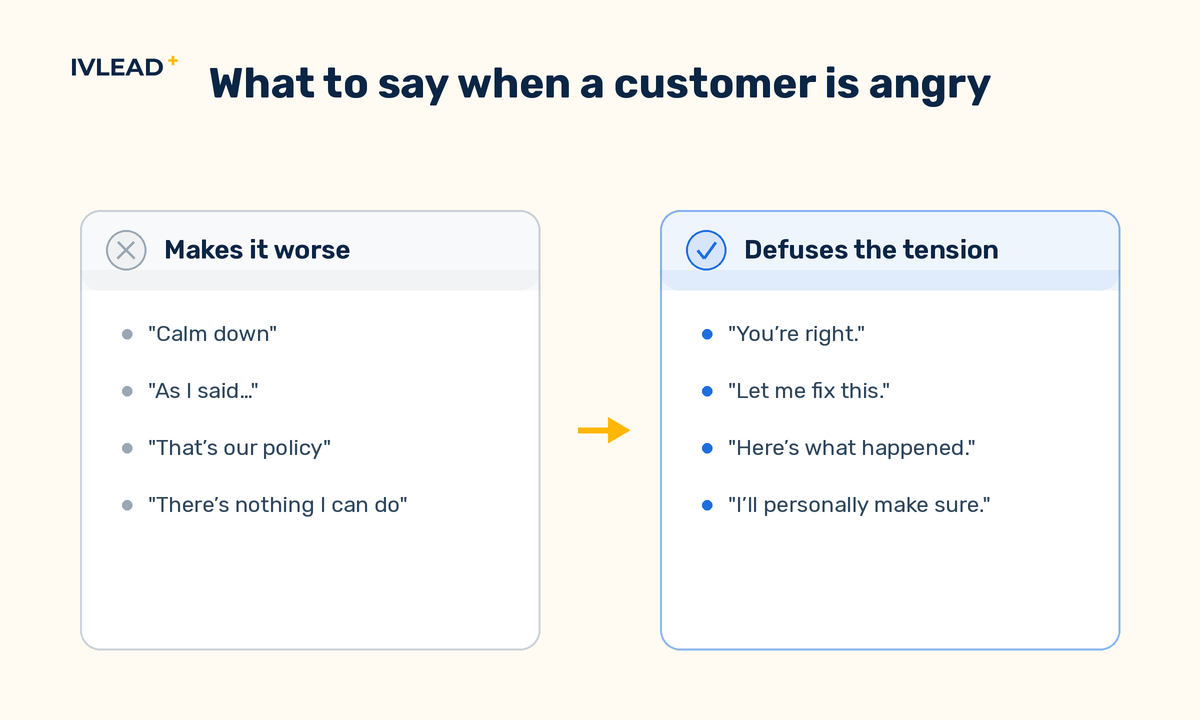
Avoid over-apologizing, too — a single sincere acknowledgement beats five hollow “so sorry”s. And never argue about who’s right; even when the customer is mistaken, winning the argument loses the relationship.
How do you de-escalate over email or chat, without tone of voice?
In writing you lose tone, so clarity and a concrete commitment have to do the work a calm voice does on a call. Lead with the acknowledgement in the first line — before any explanation — so it’s the first thing they read. Be specific about the next step and the timing (“I’ve escalated this to our billing lead and you’ll have an answer by 4pm today”), and keep the reply short and human; long, hedge-filled paragraphs read as evasion. One thing email and chat give you that a live call doesn’t: a few seconds to check the customer’s history before you respond — use them.

How do you stop the same escalations from repeating?
Give every agent the full customer context, and feed recurring complaints back into the product and process. The fastest de-escalation is the one that never has to happen because the agent already knows the customer’s history.
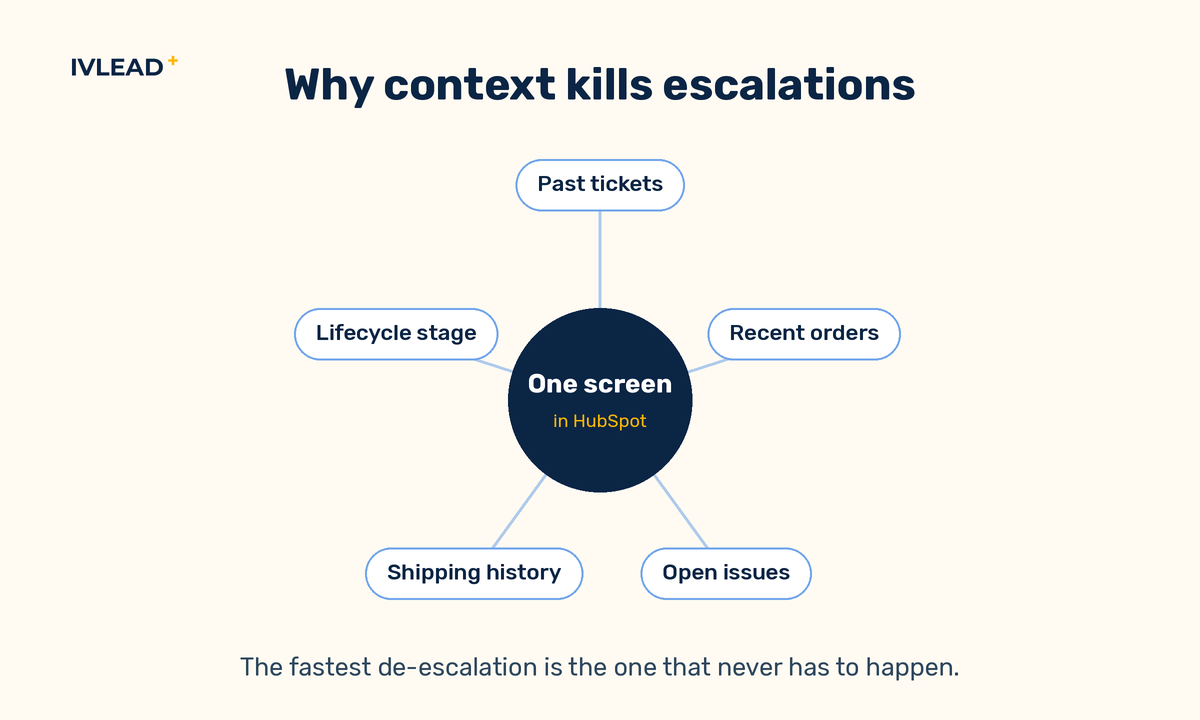
When support sees past tickets, recent purchases, and open issues on one screen, the customer never has to start over — which is the single biggest trigger for anger. Worked example: a connected support setup shows the agent that this customer’s order shipped late twice before, so the agent leads with that context and a goodwill gesture, instead of treating it as a first-time complaint. Just as important, tag and review recurring issues so the same friction stops generating tickets at all. That visibility is exactly what a well-run HubSpot setup is built to give a support team.
The IV-Lead take
De-escalation is a skill, but it scales on a system. The calmest agent in the world still struggles if they can’t see who they’re talking to or what’s already gone wrong. The teams that handle tense conversations well pair good human instincts — listen, acknowledge, slow down, act — with tooling that puts the full customer story in front of every agent, every time. Get both right and most escalations defuse before they start; get only one and you’re rolling the dice on each conversation.
Want your support team to see the full customer story on one screen? Book a 30-minute portal audit — we’ll show you where your support setup is leaving agents (and customers) in the dark. For the bigger picture, see how we approach HubSpot Service Hub setup and HubSpot implementation.
Frequently asked questions
What’s the first thing to do when a customer is angry?
Let them finish, then acknowledge the feeling before you explain anything. People escalate when they feel unheard, so the fastest way to lower the temperature is to show you’ve actually listened.
What phrases should I avoid with an upset customer?
Avoid “calm down,” “as I said,” “that’s our policy,” and “there’s nothing I can do.” They sound defensive or robotic. Replace them with ownership language: “you’re right,” “let me fix this,” “here’s what I’ll do now.”
How do I de-escalate over email or chat, without tone of voice?
Lead with acknowledgement, be specific about the next step and timing, and keep replies short and human. In writing, clarity and a concrete commitment do the work that a calm voice does on a call.
How do we reduce escalations across the whole team?
Give every agent the customer’s full history on one screen so people never have to repeat themselves, and review recurring complaints to fix the root cause. Most escalations are preventable with better visibility and follow-through.