


Many leadership teams trust their CRM right up until the numbers get questioned in a board meeting. Then the truth comes out: duplicate companies, deals with no close date, “closed-won” that never invoiced, contacts that bounced six months ago. CRM data doesn’t fail all at once — it decays, a little every month, until the reports you run no longer match the business you run. It doesn’t have to be like that, though: you can measure how dirty your CRM is and clean it up — without sacrificing a junior analyst to a quarter of spreadsheets. First, let’s look at why CRM data deteriorates so quickly, then walk through the 6-point health check we use to uncover and fix the problem.
Why does CRM data go bad so fast?
Because it’s alive. People change jobs, companies get acquired, reps enter deals in a hurry, two integrations create the same contact twice. Industry estimates put data decay at roughly a quarter to a third of a database per year — and in a fast-moving B2B portal it’s often worse. A 10,000-contact database losing 2–3% of accuracy a month is, within a year, a database where roughly a quarter of what you’re forecasting and emailing against is wrong. You don’t feel it day to day; you feel it the moment you need the data to be right.
What’s the 6-point CRM health check?
- Duplicates. How many contacts and companies exist twice (or more)? Search for your top client by domain — if two or three records come back, multiply that across the database.
- Deal-stage discipline. Do your stages mean the same thing to everyone? Count deals sitting in a stage past its realistic time, and deals missing a close date. A pipeline you can’t date is a pipeline you can’t forecast.
- Lifecycle integrity. Are “MQL,” “SQL,” and “Customer” applied consistently, or has everyone invented their own definition? Mismatched lifecycle = marketing and sales arguing over the same contact.
- Contactability. What share of your email database is actually deliverable? Hard bounces and unsubscribed addresses inflate your “reach” and tank your sender reputation.
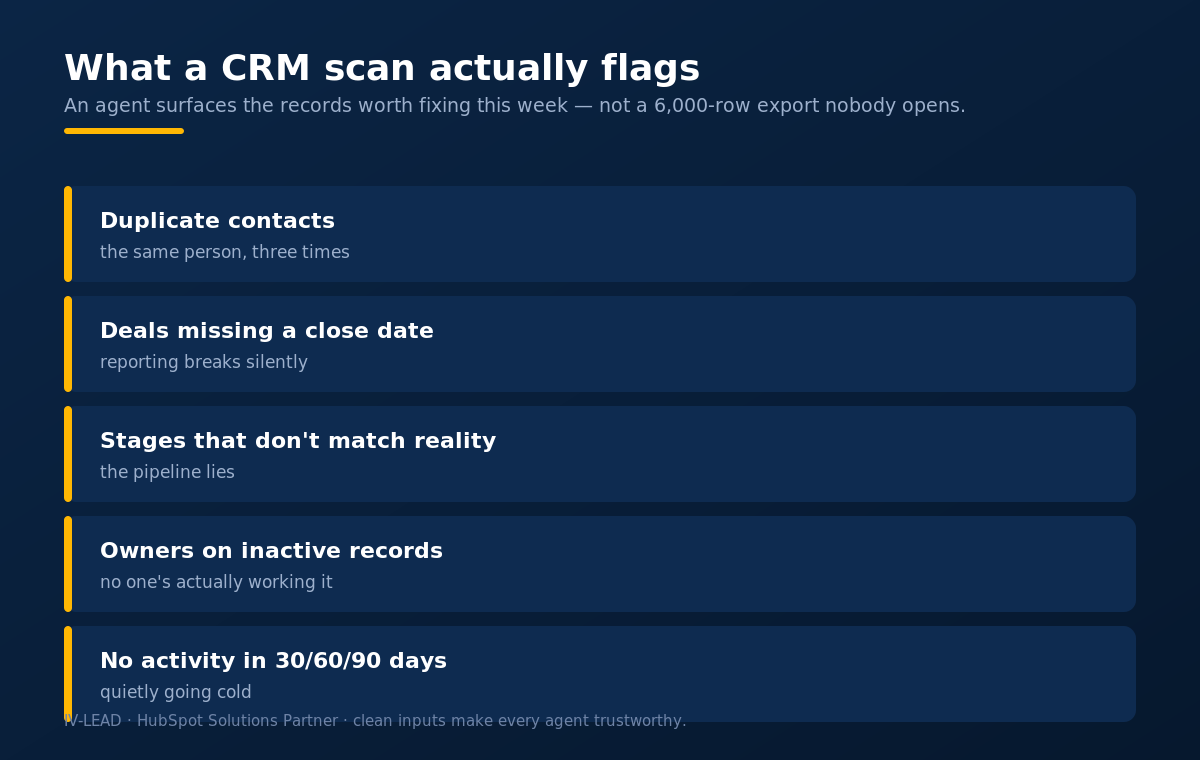
- Ownership & activity. How many open deals and key accounts have no owner, or no activity in the last 14–30 days? Unowned and untouched is where revenue quietly leaks.
- Reporting trust. The acid test: do two people running the “same” report get the same number? If not, the problem isn’t the report — it’s the data underneath it.
What cleanup used to cost — and what it costs now
CRM cleanup has traditionally been labor-intensive: teams manually identify duplicates, update records, and correct data-quality issues. Today, AI agents can automate much of the detection and prioritization work.
- The old way: someone exports the database, fights it in a spreadsheet for days, merges duplicates by hand — and the rot is back within a quarter.
- The new way: an AI agent runs the six checks on a schedule, surfaces only the records that actually need a human decision, and keeps the portal clean continuously instead of in a painful once-a-year purge. Instead of “35 hours of quarterly cleanup,” the agent delivers a weekly 30-record worklist — cleanup becomes a 20-minute habit, not a lost week. The human still makes the judgment calls (merge these two? archive this account?); the machine does the finding.
What’s the actual cleanup framework?
Do it in this sequence — cleaning out of order just creates a new mess.
- Measure. Run the 6-point check and write down the real numbers. You can’t improve what you won’t quantify.
- De-duplicate. Merge contacts and companies first, so every later fix lands on one true record.
- Standardize the model. Lock property definitions, deal stages, and lifecycle stages so new data comes in clean.
- Fix ownership & hygiene. Assign orphaned records, close dead deals, suppress undeliverable contacts.
- Automate the upkeep. Put the recurring checks on a schedule — workflows for the deterministic ones, an agent for the judgment ones — so you never decay back.
- Re-measure. Re-run the check weekly or monthly. Clean is a state you maintain, not a project you finish.
The IV-Lead take
A dirty CRM isn’t a system failure — it’s an upkeep failure, and upkeep is exactly what teams deprioritize. The shift worth paying attention to in 2026 is that the most tedious part — the finding — can now run itself, which finally makes “always clean” realistic instead of aspirational. But automation amplifies whatever it’s pointed at: clean inputs, faster trust; messy inputs, faster mistakes. Get the model right first, then let the machine keep it that way.
Not sure how dirty yours really is? Book a 30-minute portal audit — we’ll run the 6-point check on your portal and hand you the real numbers, plus the three highest-leverage fixes.
FAQ
How often should we run a CRM health check?
We run the full 6-point check quarterly and a lightweight version monthly. The point isn’t the calendar — it’s catching decay before it shows up in a forecast. Once an agent is handling the upkeep, the “check” becomes a weekly worklist you skim in a few minutes rather than a project you schedule.
Can an AI agent clean our CRM completely on its own?
No — and you wouldn’t want it to. The agent does the finding: running the checks, surfacing duplicates, flagging stale deals and undeliverable contacts. The judgment calls — merge these two records? archive this account? — stay with a human. The win is that the tedious 90% runs itself, so the person only spends time where their decision actually matters.
Which data problem should we fix first?
De-duplication, always. If you fix ownership, lifecycle, or deal stages before merging duplicates, every fix lands on a record that’s about to get merged away — so you do the work twice. Measure first, merge second, then standardize and clean.
Won’t cleaning up the CRM accidentally delete important data?
Not if it’s sequenced properly. Merging combines records rather than deleting them, undeliverable contacts get suppressed (not erased), and dead deals get closed with a reason rather than wiped. We measure before and after every pass, so nothing changes silently.