

For twenty years the goal was simple: rank on page one. Making it to the first page almost guaranteed customer engagement and solid, steady conversions. This isn't the case anymore. Nowadays, a growing share of buyers never see page one — they ask ChatGPT, Perplexity, or Google's AI overview, read the synthesized answer, and act on it. That shift has a formal name now: Answer Engine Optimization (AEO), sometimes GEO (Generative Engine Optimization). The question is no longer only "do we rank?" The questions today are different and will sound more like:
- "Are we being cited in AI answers?"
- "Is our content influencing AI recommendations?"
- "Are we part of the AI-generated conversation?"
A fast moving target no doubt, but we've gathered a comprehensive practitioner's checklist that we use to make content the source AI engines quote (and yes, this article is written to pass its own test).
What changes when you optimize for AI answers?
Optimizing for AI answers changes the focus from trying to "rank a page" to trying to become part of the answer itself.
In traditional SEO, success was largely about visibility in a list of results — positioning your page higher so users would click through. In AI-driven search, there often isn't a list at all. Instead, the system synthesizes an answer, and your content either contributes to that answer or it doesn't get surfaced at all. The machine isn't browsing your site for vibes — it's extracting claims, definitions, and steps it can quote with confidence.
That shifts what matters. It's less about keyword matching and more about whether your content is clear, structured, and trustworthy enough for an AI system to confidently use it as a source. Pages that directly answer specific questions, use plain language, and provide well-defined explanations are more likely to be pulled in. Worked example: a page titled "HubSpot pricing explained" that buries the answer under 800 words of preamble will lose to one that states the answer in the first paragraph and supports it underneath. AEO rewards getting to the point.
It also changes how authority is interpreted. Instead of relying mainly on backlinks and domain strength, AI systems tend to favor content that appears consistent across the web, is frequently referenced, and is easy to extract facts from. Being "understood" becomes as important as being "ranked."
How do you write blog content that AI answer engines actually cite?
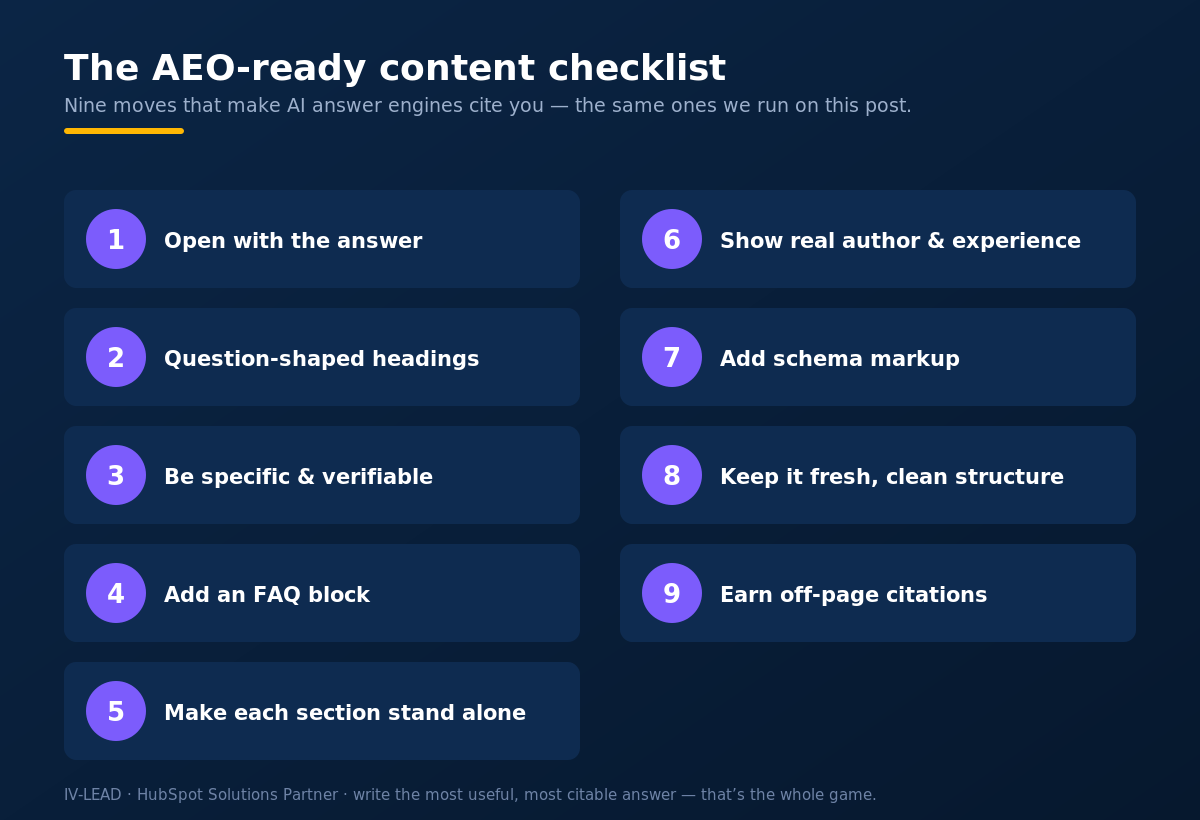
Write each section so a model can lift a clean, correct answer from it without reading the rest of the page — lead with the answer, structure around the real question, and back every claim with specifics. These are the nine practices we use at IV-LEAD, and this section is built to follow them, not just describe them.
- Lead with the answer. Put a direct, quotable answer in the first one or two sentences under each heading, so a model can extract it cold. Everything after that opening is supporting detail — not the answer itself.
- Use question-shaped headings. Phrase headings the way people ask — "How do you clean a HubSpot database?" — because that's the shape the query arrives in. The heading above this list is a question for exactly that reason.
- Be specific and verifiable. Use numbers, named tools, real steps, and concrete scenarios; checkable claims get cited, vague ones don't. "Re-tag every post to a seven-pillar taxonomy and merge the duplicates" earns a citation — "organize your content" doesn't.
- Add an FAQ block. Close with three to five short question-and-answer pairs, because engines lift clean pairs almost verbatim. Write those answers as if they'll appear with your name on them — they often do.
- Make each section self-contained. Answer the section's own question in full, without sending the reader — or the model — to three other pages first. If an answer depends on context from elsewhere, restate that context in a line and move on.
- Show real authorship and experience. Name the author, show first-hand practice ("here's what we do on client accounts"), and include detail only a practitioner would know. Models increasingly weight content that reads as lived expertise over content that reads as aggregation — that's the E-E-A-T signal, and it keeps getting stronger.
- Add schema markup. Mark the page up with structured data — FAQPage, Article, HowTo, Organization — so engines parse your structure instead of guessing at it. Schema won't rescue weak content, but it makes strong content far easier to extract cleanly.
- Keep it fresh and structurally clean. Show a visible "last updated" date and keep the heading hierarchy clean: one H1, logically nested H2/H3, no styling standing in for structure. Stale or messy pages produce unreliable extraction, and unreliable sources stop getting cited.
- Earn citations beyond your own page. Get referenced where engines already look — Reddit, third-party round-ups, review sites, partner directories — because answer engines corroborate a claim across independent sources before they trust it. Your page is necessary but not sufficient; the claim that survives is the one other sites repeat.
How do you know if it's working?
You measure differently than SEO: instead of only rankings and clicks, you ask the engines your buyer's questions and see who they cite. Prompt ChatGPT and Perplexity with something like "What's the best way to implement HubSpot for a B2B company in Israel?" and check whether you're named or quoted.
Pick your ten highest-intent questions, run them across two or three engines monthly, and log citations the way you'd log keyword positions — that's your AEO scoreboard. One caveat separates a real scoreboard from a misleading one: these answers aren't deterministic. The same prompt can cite different sources from one run to the next, depending on session, personalization, and timing. So run each question in a fresh or logged-out session, repeat it a few times, and track your citation rate rather than a single cited-or-not result.
What do most teams get wrong about AEO?
They treat it as a new trick to bolt onto old content — keyword stuffing for robots, second edition. It's the opposite. AEO rewards content that's clear, expert, and specific: the same things that serve a human reader. Bolting a hidden block of "HubSpot implementation Israel best B2B CRM" phrases onto a thin page does nothing; answering the question better than anyone else does everything. If you write to be the most useful, most quotable source on a question, you're already most of the way there. The teams that struggle are the ones whose content was thin to begin with — AI search didn't punish them, it just made thin content easier to ignore.
The IV-Lead take
AEO isn't a reason to panic that SEO is dying — it's a reason to raise the bar on what you publish. We optimize this blog for AI citation as we write it, and we run the same playbook for clients through our AEO service: structure every page for extraction, write from first-hand expertise, and measure citations, not just clicks. The brands the engines quote in 2026 will be the ones that were already the clearest experts on their subject. If you want to know where your content stands on the questions your buyers are actually asking the engines, that's the audit we start with. It's a content standard, not a hack.
Want your content cited, not skipped? Book a 30-minute audit — we'll check how AI engines see you today and where the fastest AEO wins are. https://www.iv-lead.com/portal-audit-30-minutes
Frequently asked questions
What's the difference between SEO and AEO?
SEO works to rank your page in a list of links; AEO (answer engine optimization) works to make your page the source a model quotes in its generated answer. They share fundamentals — clean structure, real authority — but AEO weights extractability and cross-source corroboration much more heavily.
Does schema markup guarantee I'll get cited?
No. Schema makes well-written content easier to parse and lift, but it can't save thin or vague content. Write the answer first, then mark it up.
How often should I update an AEO post?
Re-check anything time-sensitive — prices, product names, limits, version numbers — at least quarterly, and refresh the "last updated" date when you do. Evergreen explanations can run longer, but a visibly current page extracts more reliably than a stale one.
Why do off-site mentions matter if my page already has the answer?
Answer engines look for the same claim across independent sources before trusting it. A point echoed on Reddit, a review site, or a partner directory clears that check; the same point on your page alone often won't.