

"Should we go with HubSpot or Salesforce?" is one of the most common questions we hear from B2B teams — and it's the wrong question. Both are excellent CRMs. The real question is which platform fits the way your revenue team actually operates, how fast you need to see value, and how much custom engineering you want to own. Get that right and the CRM disappears into the background. Get it wrong and you spend two years fighting your own tooling.
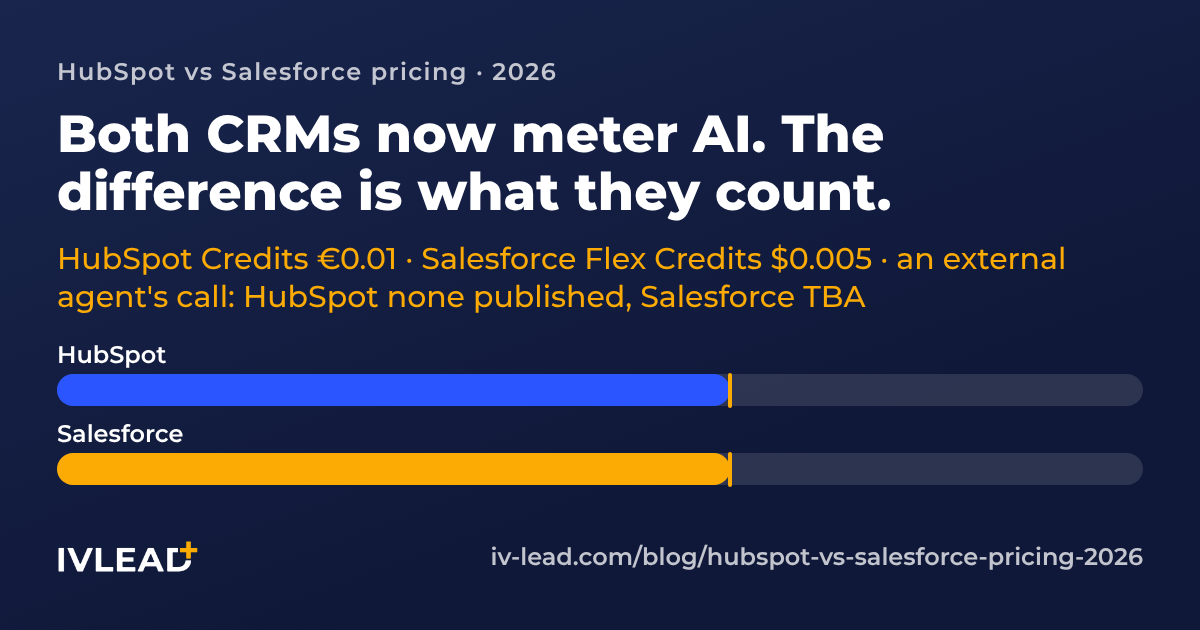
Update, 26 October 2026: both CRMs now meter AI in credits, and Salesforce plans to charge for external AI-agent calls, with November as its target, at a rate it hasn't published. We compared seats, HubSpot Credits against Salesforce Flex Credits, and the new charge, from list prices with read dates: HubSpot vs Salesforce pricing 2026: what does each CRM meter, and what can you control?
As a HubSpot Solutions Partner that also migrates teams off Salesforce, here's our honest, practitioner's view — including where Salesforce is the better call.
The short answer
For most B2B companies up to mid-market — especially those that want marketing, sales, and service on one system and a fast time-to-value — HubSpot is usually the better fit. For large enterprises with deeply bespoke processes, a dedicated admin/dev team, and complex multi-cloud requirements, Salesforce earns its complexity. Most teams overestimate how much customization they actually need.
Running Priority or SAP Business One as your ERP? That constraint changes the whole decision — we wrote a dedicated guide for exactly that architecture: HubSpot vs Salesforce for an Israeli B2B company running Priority or SAP B1.
HubSpot vs Salesforce at a glance
| Dimension | HubSpot | Salesforce |
|---|---|---|
| Time to value | Fast — weeks | Slower — often months |
| Ease of use | Built for end users; low admin overhead | Powerful but admin/dev-dependent |
| All-in-one | Marketing, Sales, Service, CMS, Ops in one platform | Best-in-class sales core; the rest via clouds/AppExchange |
| Customization ceiling | High for most needs, bounded by the platform | Effectively unlimited with development |
| Total cost of ownership | Lower — fewer admins, less integration glue | Higher — licenses + admin + dev + integrations |
| Reporting | Strong out of the box | Extremely deep, but needs setup expertise |
| Best fit | SMB to mid-market revenue teams wanting one source of truth | Enterprise with dedicated ops/dev and bespoke processes |
Where HubSpot wins
Speed and adoption. HubSpot is designed for the people who actually use it — reps, marketers, CSMs — not just admins. A portal can be live and driving pipeline in weeks, and your team actually logs activity instead of avoiding the CRM.
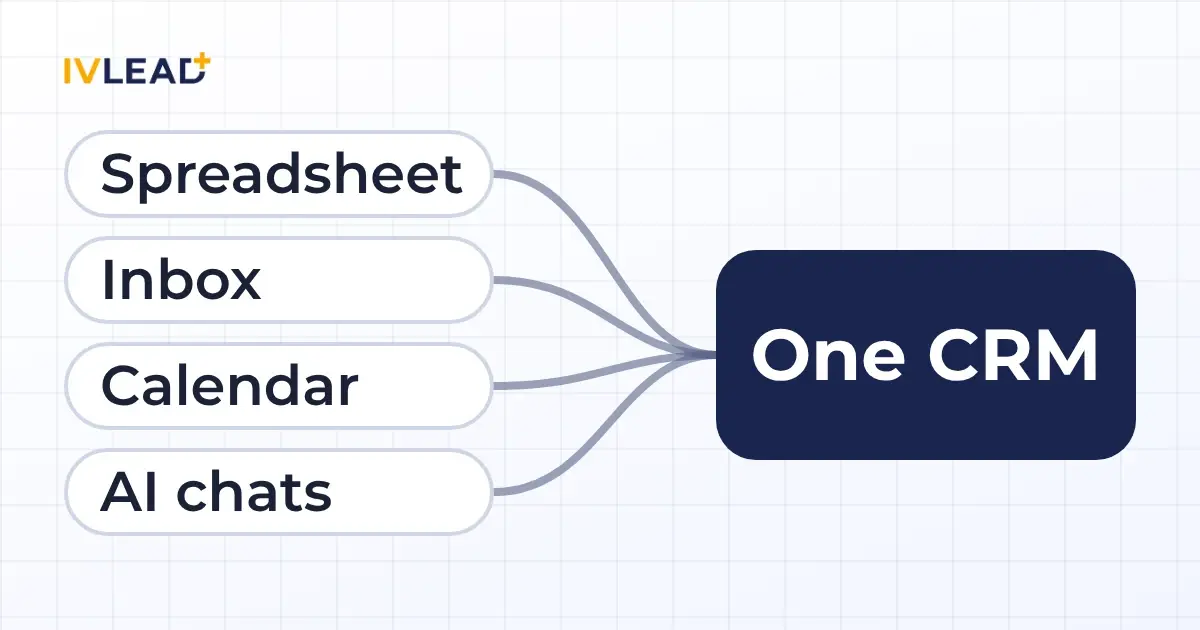
One platform, one source of truth. Marketing, sales, service, CMS, and operations share the same data model. No stitching three tools together with brittle integrations — the thing that quietly breaks most "Salesforce + marketing tool" stacks.
Lower total cost of ownership. The license is only part of the bill. HubSpot's real saving is that it needs far less admin and developer time to keep running, which is where Salesforce budgets balloon.
Where Salesforce wins
We're a HubSpot partner, and we'll still tell you plainly: Salesforce is the right choice for some teams. If you have deeply customized, non-standard processes, need granular permissioning across many business units, run complex multi-cloud requirements, and already have a dedicated Salesforce admin/developer team, Salesforce's near-unlimited customization is a genuine advantage. The trade-off is that all that power demands ongoing engineering — it is not a set-and-forget system.
What we actually see in practice
Most of the migrations we run share the same story: a team chose Salesforce expecting to need heavy customization, then spent more on admins and consultants than on the licenses — and reps still under-used it. When they move the standard 80% of their process onto HubSpot and keep the genuinely custom 20% intentional, adoption jumps and reporting finally becomes trustworthy.
The lesson isn't "HubSpot beats Salesforce." It's that the platform should match your operating model, not your ambitions for one. Pick for how your team sells today and where you'll be in 18 months — not for a hypothetical level of complexity you may never reach.
Frequently asked questions
Is HubSpot cheaper than Salesforce?
Usually yes — not always on license sticker price, but almost always on total cost of ownership, because HubSpot needs less admin, developer, and integration spend to operate.
Can you migrate from Salesforce to HubSpot without losing data?
Yes. A clean migration maps objects, properties/fields, associations, and historical activity, then validates record counts and reporting before cutover. The risk isn't the data — it's migrating a messy process unchanged. We clean as we move.
Is Salesforce more powerful than HubSpot?
For deep, bespoke enterprise customization, yes. For most B2B revenue teams, HubSpot is powerful enough — and the difference in adoption and speed outweighs the extra ceiling you won't use.
Which CRM is better for B2B?
For SMB to mid-market B2B that wants marketing, sales, and service unified with fast time-to-value, HubSpot. For large enterprises with dedicated ops/dev teams and highly custom processes, Salesforce.
Choosing with confidence
The best CRM is the one your team will actually use to run revenue — and the right answer depends on your processes, not the logo. If you want a straight, partner's read on which fits your operating model (and a clean migration path if it's HubSpot), book a call with IV-Lead. We'll tell you honestly which way to go, even when it's not us.