


B2B selling has more people, longer cycles, and more touchpoints than a CRM-free spreadsheet can hold together. HubSpot CRM matters for B2B companies because it gives sales, marketing, and service one shared source of truth — so the right person follows up at the right time, handoffs stop leaking, and leadership can actually see what's working. The reasons people list run long, but they all reduce to a few that hold up under scrutiny. Here's the practitioner's read on the ones that matter, each with the concrete so-what.
Why is HubSpot CRM important for B2B companies?
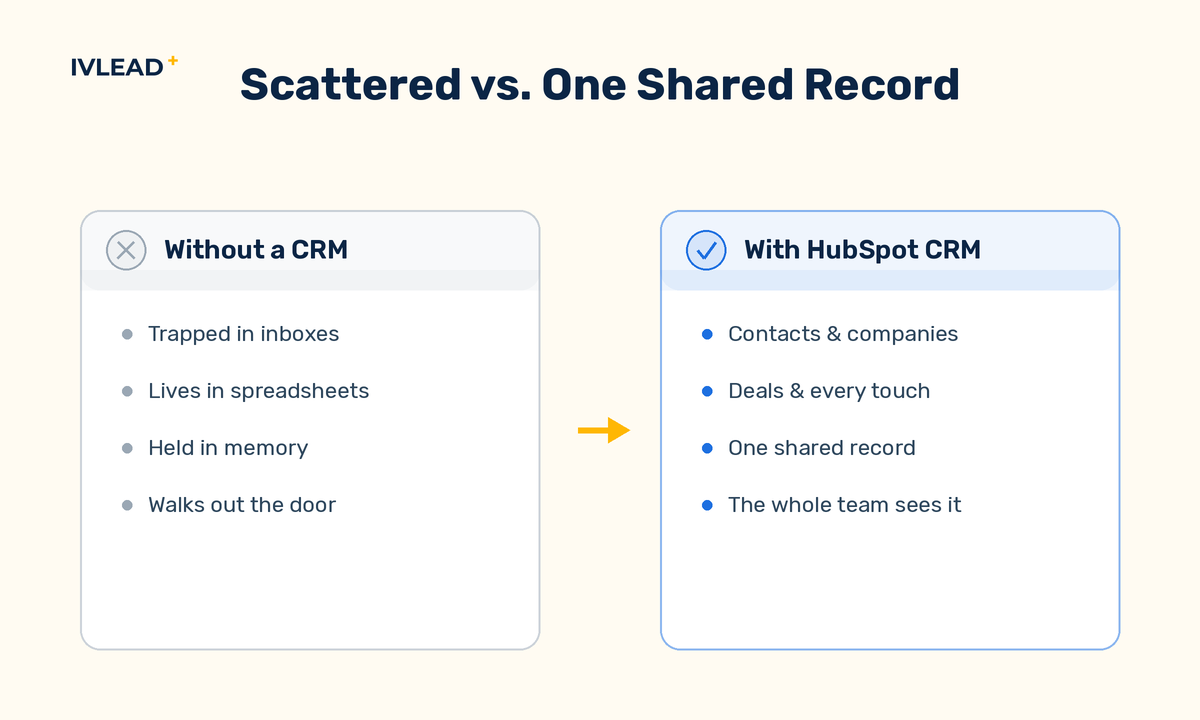
Because B2B revenue is a team sport played over months, and HubSpot keeps every account, deal, and interaction in one record that every team can see and act on. In a typical B2B deal, an SDR, an AE, a marketer, and a CSM all touch the same account across a long cycle. Without a CRM, that history lives in inboxes and personal memory — and it walks out the door when someone leaves. A shared system means the next person picks up exactly where the last one left off, instead of starting cold and re-asking questions the customer already answered.
What problem does a CRM actually solve for B2B?
It replaces scattered, personal knowledge with a shared record everyone can see and act on. The so-what is continuity: when a prospect replies to a nurture email, the AE opens one record and sees the full thread, the last call notes, and the open deal — instead of guessing at context. Continuity is what keeps a long, multi-person deal from stalling every time it changes hands. It also means a rep's departure doesn't erase the relationship; the account stays intact because the knowledge was never trapped in one head.
How does HubSpot help sales and marketing pull in the same direction?
One platform means marketing's leads and sales' deals live in the same system, so handoffs stop leaking and revenue can be traced back to its source. The classic B2B failure is marketing generating leads that sales never works, with each side blaming the other. When both run on HubSpot, a lead's source, score, and full activity history follow it into the pipeline, and reporting ties closed revenue back to the campaigns that earned it. That shared view is what turns "marketing-qualified leads" from a standing argument into a number both teams trust — and it tells you which programs to fund and which to cut.
Why does reporting get singled out so often?
Because you can't improve a pipeline you can't see, and the CRM is what makes the pipeline visible. HubSpot's reporting answers the questions B2B leaders actually ask: where deals stall, which sources produce revenue, how long the cycle really takes, and what each rep's pipeline looks like. The catch — and the real work — is that this visibility only holds up if the data underneath is clean and the deal stages are honest. Good reporting is a downstream reward for disciplined data entry and a well-defined sales process, not a feature you flip on. Get the inputs right and forecasting stops being a guess.
How does a CRM let a B2B team scale without adding chaos?
Automation handles the routine so people handle the judgment — and the system absorbs volume that would otherwise break a manual process. Workflows route leads, create tasks, and trigger follow-up so nothing falls through the cracks as deal volume climbs. The so-what shows up in onboarding too: bringing on a new rep means handing them a portal with full account history, not a folder of tribal knowledge and a week of shadowing. The team grows; the chaos doesn't.
What does "one platform across the customer lifecycle" buy a B2B company?
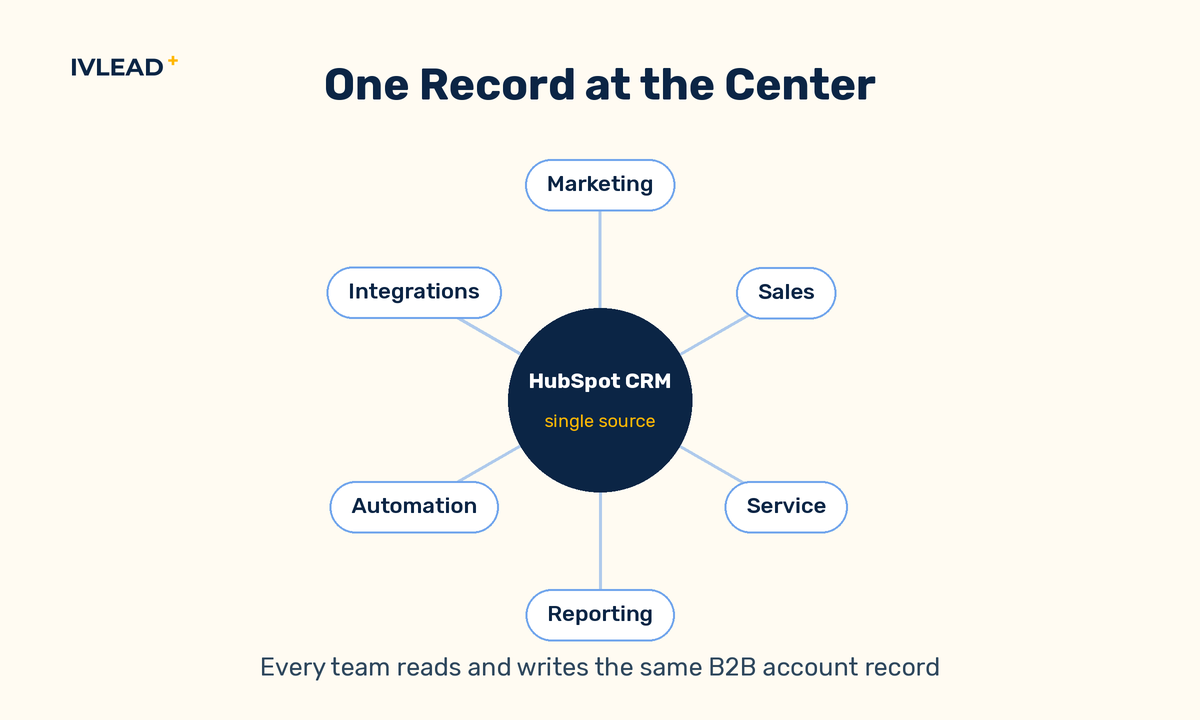
It keeps the customer's experience consistent from first touch to renewal, because marketing, sales, and service all read and write to the same record. In B2B, the relationship doesn't end at the signed deal — expansion and renewal are where the real value compounds. When service and success work in the same system, a CSM sees the original sales promises and the marketing history, and an account flag during onboarding is visible to the AE before the renewal conversation. Nothing gets dropped in the handoff between "won" and "kept."
Why does HubSpot specifically suit B2B over a generic CRM?
Because B2B is account-led, and HubSpot models the company and its associations — not just the individual contact. A B2B buying decision involves multiple stakeholders inside one organization, so the CRM has to connect people to companies, deals to accounts, and activity across the whole buying group. HubSpot also consolidates marketing, sales, and service in one place and integrates with the rest of the stack — so instead of stitching together disconnected point tools, you get one trusted record with the surrounding work built around it. For most B2B teams the win isn't a longer feature list; it's fewer systems pretending to agree.
The IV-Lead take
HubSpot CRM isn't valuable because of a long feature list; it's valuable because it gives a B2B company one trusted record of every account and deal, plus the discipline to keep it clean. The platform is only as good as the data and process inside it — a CRM with messy data is just a more expensive spreadsheet. Get the foundation right and every reason above becomes real instead of theoretical. That foundation work — clean data, honest stages, automation that fits how the team actually sells — is exactly what we do.
Wondering whether your HubSpot is set up to deliver these benefits? Book a 30-minute portal audit — we'll look at your portal together and tell you straight where it's working and where it's leaking. For the bigger picture, see how we approach HubSpot implementation and optimization and the RevOps work that keeps the data trustworthy.
Frequently asked questions
Is HubSpot CRM a good fit for small B2B companies?
Yes — it scales from a small team to an enterprise without forcing a replatform later. Start with the contacts, companies, and deals you need, and add capability as you grow rather than buying complexity up front.
What makes B2B different from B2C in a CRM?
B2B deals involve multiple stakeholders, longer cycles, and account-level relationships, so company records and associations matter as much as individual contacts. The CRM has to model the account and the buying group, not just the person.
Does HubSpot replace our sales and marketing tools?
It can replace several and it integrates with the rest. The value is one source of truth — so audit what you have and consolidate where it removes friction, rather than adding another disconnected tool to the pile.
What's the most common reason HubSpot underdelivers for B2B teams?
Messy data and inconsistent deal stages. The reporting and automation only work on trustworthy data, so the hygiene and process discipline are what turn the benefits from theoretical into real.