

In 2026 the honest answer to "HubSpot or Salesforce?" is that both are excellent CRMs, and the right choice depends far more on who runs it and how complex you really are than on any feature gap. Most answers online are vendor spin or a feature checklist nobody finishes. This is the practitioner's version. Full disclosure: we're a HubSpot partner — but we've migrated teams both directions, and inherited both platforms run beautifully and run into the ground, so we'll tell you straight where each one wins.
Is there still a real feature gap between HubSpot and Salesforce in 2026?
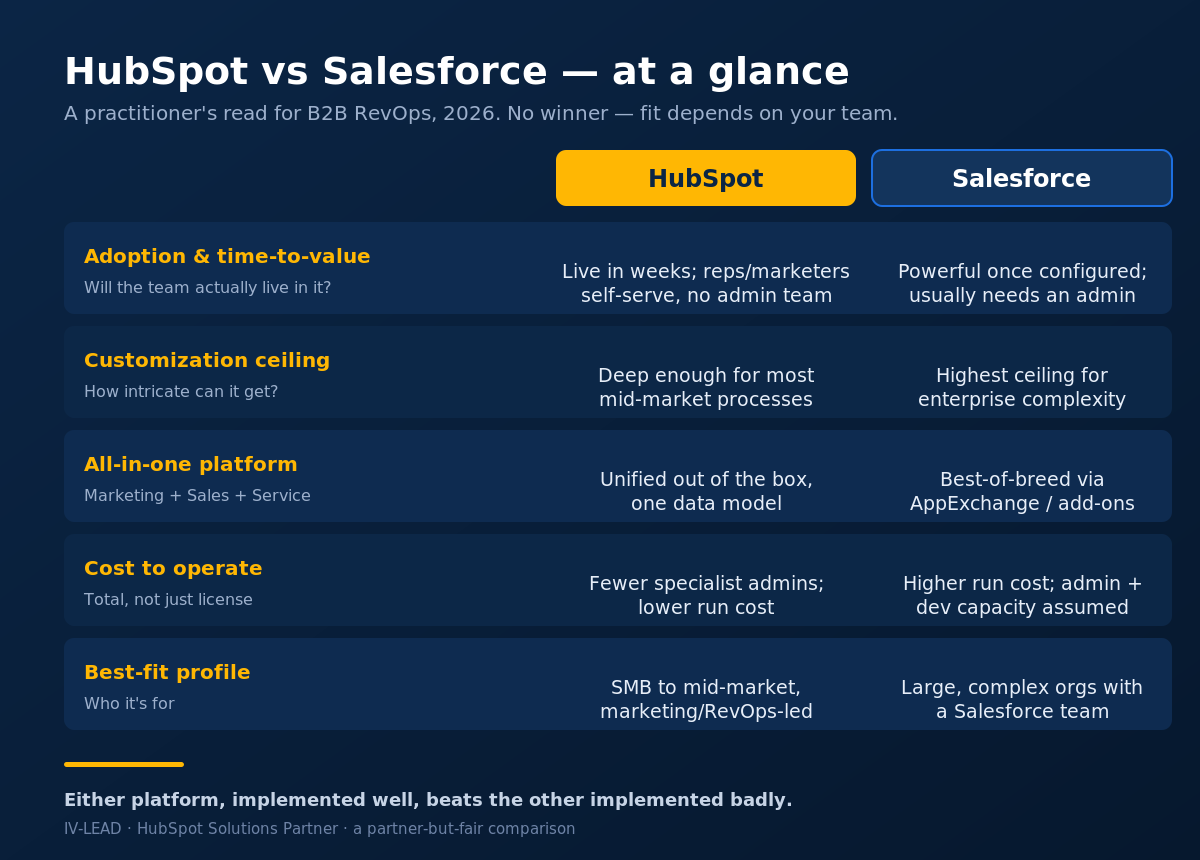
Not the one that used to define this debate. HubSpot has moved firmly upmarket; Salesforce remains the enterprise standard — and for the vast majority of B2B teams, both can model the pipeline, automation, reporting, and lifecycle you need. So "which is more powerful?" is the wrong question. A CRM nobody adopts is worthless at any price. The two questions that actually carry money are adoption (will your team live in it?) and total cost to operate (what does it take to keep it running?). Optimize for those, not the spec sheet.
Where does HubSpot actually win?
On time-to-value and adoption — it's usable by the people who live in it without a dedicated admin team. Reps, marketers, and CS can build and change things themselves, so the system keeps matching the business instead of ossifying.
Worked example: a 30-person B2B SaaS team we onboarded went live on a clean HubSpot pipeline in a few weeks — marketing, sales, and service on one timeline, one data model, no integration project to hand a lead from a campaign to a rep. The marketing-to-sales handoff that's a quarter-long systems-integration effort in many Salesforce orgs was a property and a workflow.
HubSpot tends to win when you're SMB to mid-market, marketing-led or RevOps-led, and you want to move fast without a Salesforce admin on payroll. The cost advantage shows up less in license line items and more in the specialists you don't have to hire to keep the thing alive.
Where does Salesforce actually win?
On ceiling — genuinely intricate, high-complexity orgs. If you run many business units, exotic approval chains, heavy custom objects, or regulated processes that need deep configurability, Salesforce has more headroom, and its AppExchange and the pool of certified Salesforce talent are vast.
Worked example: an enterprise with five business units, region-specific approval matrices, and a decade of custom objects is a case where Salesforce's configurability earns its keep — and where a team of admins and developers to wield it is a feature, not a tax. For that profile, the gravity of an existing Salesforce investment and team is real and worth respecting.
Salesforce tends to win for large enterprises with dedicated admin/dev capacity, truly complex or regulated processes, and meaningful existing Salesforce investment.
Which four questions actually decide it?
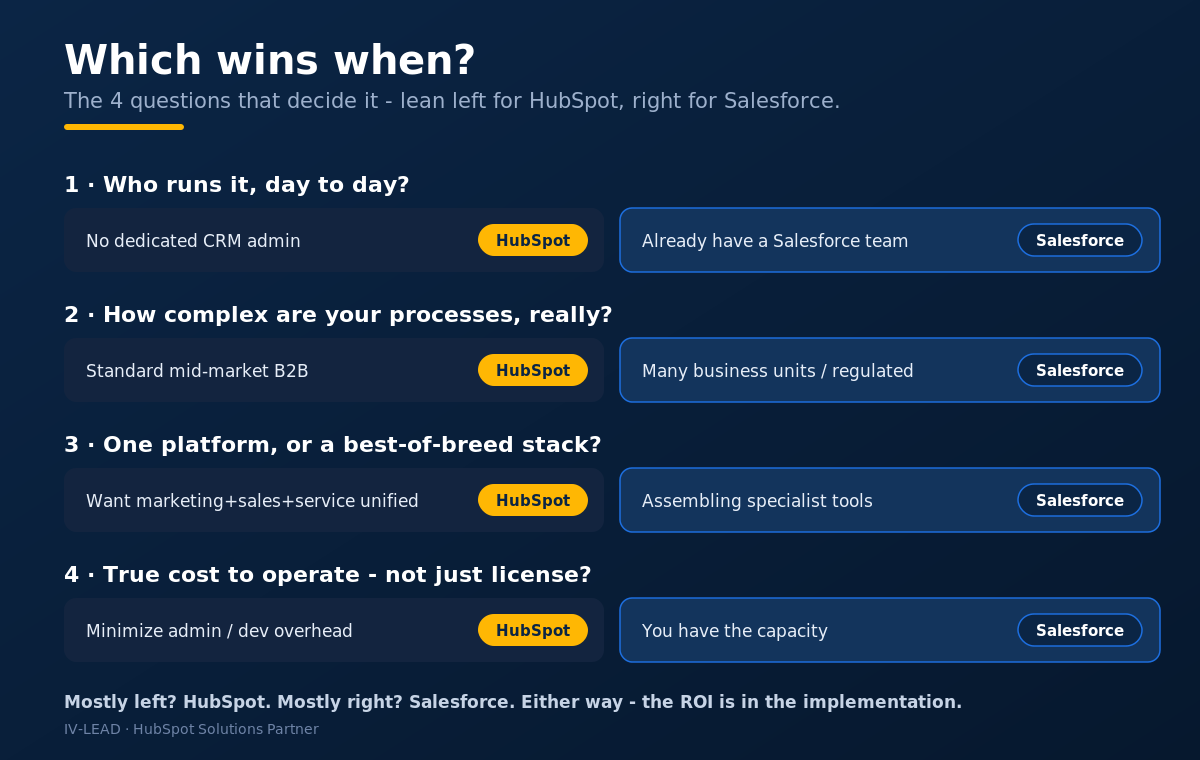
Skip the feature war and answer these — they decide it more reliably than any comparison matrix:
- Who runs it, day to day? If you don't have (and don't want) a dedicated CRM admin, that points hard at HubSpot. If you already have a Salesforce team, that gravity is real.
- How complex are your processes — honestly? Most mid-market B2B processes fit HubSpot comfortably. Teams routinely buy Salesforce for complexity they don't actually have, then pay to maintain it forever.
- One platform or best-of-breed? Want marketing + sales + service unified out of the box? That's HubSpot's structural advantage. Assembling a stack of specialist tools? Salesforce slots into that world.
- What's the true cost to operate — not just license? Add admins, developers, and change-velocity. The cheaper license is often the more expensive system.
Does the platform or the implementation matter more?
The implementation — by a wide margin. We've seen pristine Salesforce orgs and chaotic ones, and the same for HubSpot. The platform is rarely why a CRM fails; the setup is.
Worked example: a team that migrates a messy CRM without first fixing the data model doesn't fix anything — it relocates the mess onto a new logo and a bigger bill. The value lives in clean data, disciplined deal stages, real lifecycle definitions, and the integrations to your ERP and stack. That's the work, in that order, whichever platform you land on.
What's the most common mistake teams make choosing between them?
Buying for the company they imagine they are instead of the one they run. The classic version is selecting Salesforce for enterprise-grade complexity, then using maybe a fraction of it while paying — in admin headcount and change-velocity — for all of it. The mirror-image mistake is outgrowing a CRM you never configured properly and blaming the tool. Both are setup decisions wearing a platform costume.
The IV-Lead verdict
For most B2B mid-market teams — especially Israeli companies scaling globally without a large ops department — HubSpot wins on the metric that matters most: adoption per dollar and per hour. For genuinely enterprise-complex orgs with a Salesforce team already in place, Salesforce earns its keep. But the truth underneath the debate is that either platform, implemented well, beats the other implemented badly. Choose for who will run it and how complex you really are — then put the budget into the implementation, because that's where the ROI actually lives.
Frequently asked questions
Is HubSpot powerful enough to replace Salesforce for B2B?
For most SMB and mid-market B2B teams, yes — HubSpot now handles the pipeline, automation, reporting, and lifecycle complexity those teams actually use. The orgs that genuinely need Salesforce's extra ceiling are the high-complexity, multi-business-unit, dedicated-admin enterprises.
Is HubSpot cheaper than Salesforce?
The honest answer is "it depends on total cost, not license price." HubSpot usually costs less to operate because it needs fewer specialist admins and less custom development. Compare the all-in cost — licenses plus the people to run it — not the sticker.
How hard is it to migrate from Salesforce to HubSpot (or back)?
The migration's difficulty is mostly about your data and process discipline, not the platforms. A clean, well-modeled source migrates smoothly; a messy one needs cleanup first, or it just moves the mess. Fix the data model before you move it.
Which is better for RevOps specifically?
RevOps lives or dies on adoption and a single source of truth. HubSpot's all-in-one model gives most mid-market RevOps teams that out of the box; Salesforce gives larger, complex orgs more configurability at the cost of more operating overhead.
Weighing a CRM decision or a migration? Book a 30-minute call — we'll give you a straight, partner-but-fair read on the right fit for your team. → https://www.iv-lead.com/portal-audit-30-minutes