

Lead scoring exists to answer one question for your sales team: of all the leads in the database, which ones are worth a call today? A lead score is a number you assign to each lead based on how well they fit your ideal customer and how engaged they are — so sales spends time on the leads most likely to buy, instead of working the list top to bottom. The model can get sophisticated, but a basic, honest score beats a fancy one nobody trusts. Here's the practitioner's read on building one from your data in HubSpot.
Ready to build it hands-on? Follow a practical guide to HubSpot's lead scoring tool. And scoring only works on a clean list — start with building a clean lead list.
What is lead scoring, and why does it matter in B2B?
Lead scoring is the practice of ranking leads by a single number so sales works the best opportunities first instead of guessing. In B2B, where deals are considered, multi-stakeholder, and slow, that ranking matters more than in any other model: your reps have limited hours, and most of the database is never going to buy. A score turns a long, undifferentiated list into a priority order. Done right, it aligns marketing and sales on what "ready" actually means, shortens the time good leads wait, and stops reps from burning their week on names that look busy but will never close.
What goes into a lead score?
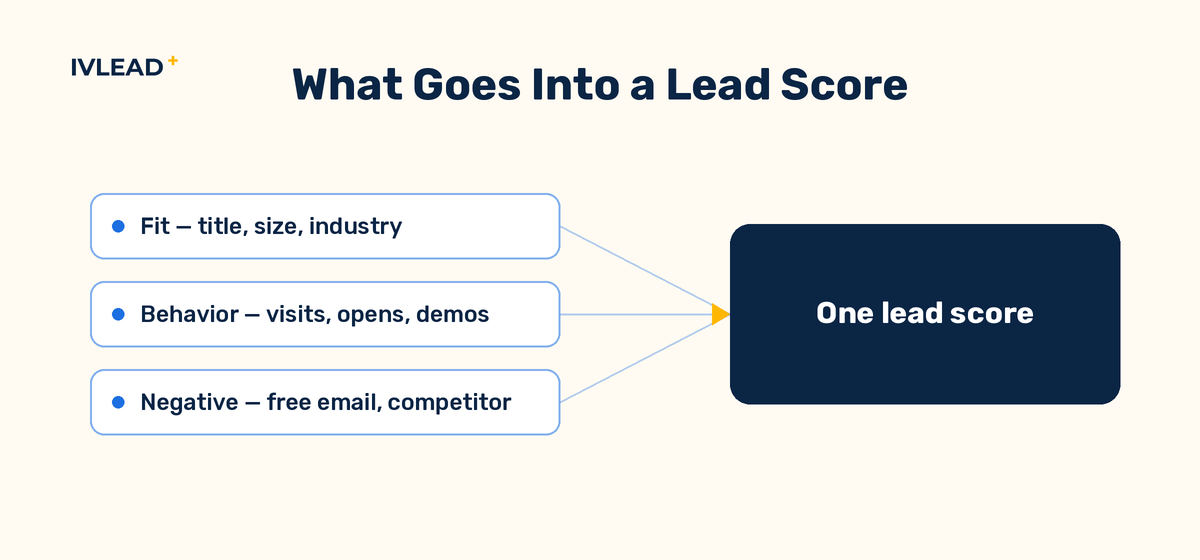
Two kinds of data: fit (who they are) and behavior (what they've done). Fit data is the demographic and firmographic match — job title, company size, industry, location — that tells you whether this lead even resembles a good customer. Behavior data is engagement — pages visited, emails opened, forms filled, demos requested — that tells you how interested they are right now. A strong score blends both, because each alone misleads: a perfect-fit lead who's done nothing isn't ready, and a highly engaged lead who's a terrible fit will never close. You assign points to the attributes and actions that correlate with real customers, and subtract points for negative signals.
Worked example: a VP of Sales at a 200-person SaaS company (strong fit) who visited the pricing page twice this week (strong behavior) should score far higher than a student who downloaded one ebook.
How do you build a basic lead score in HubSpot?
Create a score property, list the positive and negative criteria, assign each a point value, and let HubSpot total it on every contact automatically. HubSpot ships a built-in HubSpot Score property, and on most tiers you can build a manual scoring property where you define the rules yourself. The flow is the same either way:
- Pull your closed-won customers and look at what they shared — titles, company sizes, industries — and which behaviors preceded the deal.
- Write positive criteria for those signals (e.g. "Job title contains Director/VP," "Visited pricing page," "Requested a demo") and assign points by how strongly each predicts a real customer.
- Write negative criteria for disqualifiers (free email domain, competitor company, out-of-region country, unsubscribed) and assign deductions.
- Save the property. HubSpot recalculates the score on each contact as new data arrives, so the number stays current without manual work.
Keep the first version deliberately small — a dozen well-chosen rules you can explain beats forty you can't.
How do you decide what each signal is worth?
Look at your closed-won customers and weight the attributes they actually shared — let the data set the points, not your gut. The fastest way to a credible model is to study who already bought. Which job titles, company sizes, and industries show up most among your customers? Which behaviors — a demo request, repeated pricing-page visits — preceded a closed deal? Assign more points to the signals real customers shared and fewer to the weak ones. Just as important, assign negative points to disqualifiers. A score that only adds points inflates everyone; the negatives are what make it discriminate.
Worked example: if nearly every closed deal last year requested a demo, that action deserves heavy points — and a free-email-domain lead deserves a deduction, because almost none of them ever bought.
How do you set the threshold sales acts on?
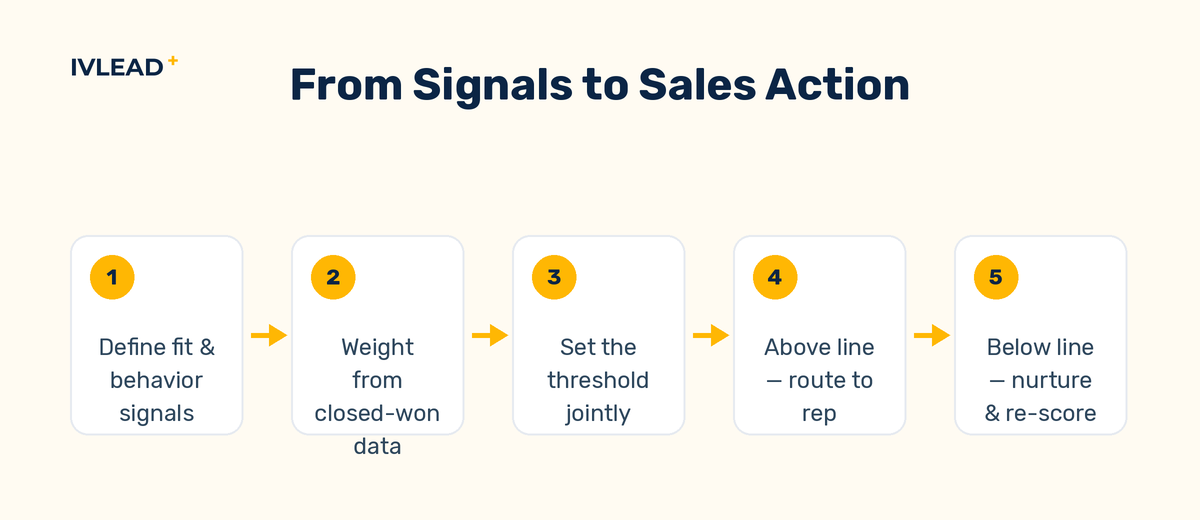
Pick the score above which a lead becomes sales-ready, and set it where the conversion data — not optimism — tells you to. The number itself is meaningless until you draw a line: at what score does marketing hand the lead to sales? Set it too low and you flood sales with weak leads and erode their trust in the score; set it too high and good leads sit ignored. Use your data — at what score do leads actually start converting? — and agree the threshold jointly between marketing and sales, because a score sales doesn't believe in is a score they'll ignore. The order matters: define fit and behavior signals from real customers, weight them, then set a threshold both teams sign off on.
How does the score drive routing and nurture?
The score is an input to your workflows: leads above the threshold get routed and assigned to a rep, leads below it get nurtured until they climb. A score only earns its keep when it triggers action. In HubSpot you wire the score property into automation: when a contact crosses the sales-ready line, a workflow sets their lifecycle stage to MQL or SQL, assigns an owner via rotation, and notifies the rep so the lead gets worked while it's hot. Leads below the line don't get dropped — they enter a nurture sequence that keeps them engaged, and their behavior keeps adding points until they cross the threshold and route automatically. That closed loop is what makes scoring operational instead of decorative.
What are the most common lead-scoring mistakes?
The big ones are scoring only on behavior, ignoring negative signals, setting the threshold by hope, and never revisiting the model. Behavior-only scores reward anyone who clicks — including job-seekers, students, and competitors — and starve sales of fit context. Skipping deductions lets every score climb until the model can't separate good from bad. Picking the threshold optimistically floods reps with weak leads and trains them to ignore the score entirely. And a model set once and forgotten quietly drifts as your market and product change. Each of these is the same failure in different clothes: a score sales stops trusting, which is worse than no score at all.
How do you keep the model honest over time?
Review it regularly against what actually closes, and adjust the weights as your market and product change. A lead-scoring model is a hypothesis, not a fact. The signals that predicted good customers last year may weaken as you move upmarket, launch a new product, or enter a new segment. Check periodically whether high-scoring leads are still the ones closing — and if they're not, recalibrate. In HubSpot you can build this with manual score properties or, on higher tiers, predictive scoring, but either way the discipline is the same: test the model against outcomes and tune it. An unmaintained score drifts until sales stops trusting it, which defeats the entire purpose.
The IV-Lead take
A basic lead score built from your own closed-won data and trusted by sales is worth more than an elaborate model built on assumptions. The two things that make or break it are the negative signals (which let the score actually discriminate) and the threshold (which only works if marketing and sales agree on it together). Start simple, weight it from real customers, set the line jointly, wire it into routing and nurture, and revisit it — that's a score that earns the sales team's attention instead of their eye-rolls.
Want a lead-scoring model your sales team will actually trust and use? Book a 30-minute portal audit — we'll show you what signals predict your real customers and how to score on them. For the build itself, see our HubSpot implementation work; for aligning the marketing-to-sales handoff around the score, see how we approach RevOps.
Frequently asked questions
What's the difference between fit and behavior in lead scoring?
Fit is who the lead is — title, company size, industry — and tells you whether they resemble a good customer. Behavior is what they've done — visits, opens, demo requests — and tells you how interested they are now. A good score uses both, because either one alone gives a misleading picture.
Why do negative scores matter?
Without deductions for disqualifiers like personal email domains, competitors, or unsubscribes, every lead's score only climbs and the model can't separate good from bad. Negative points are what let the score actually discriminate between a hot lead and an active but unqualified one.
Do I need HubSpot Enterprise for lead scoring?
No — you can build a manual scoring property on most tiers using points for fit and behavior. Predictive, AI-driven scoring is a higher-tier feature, but a well-designed manual model is enough for most teams getting started.
How often should I update my lead score?
Review it whenever your market, product, or ideal customer shifts, and at least a couple of times a year. Check whether high-scoring leads are still the ones closing, and adjust the weights if the model has drifted from reality.