Inside sales reps sell remotely by phone, email and video. Outside sales reps meet buyers in person. Choose by how your buyers buy and what a deal is worth: a visit only pays when deal size and buyer expectations justify the cost. Most B2B companies run a blend, and that blend holds only when the CRM enforces who owns which account and when a deal changes hands.
Key takeaways
- Decide the model per market segment, using deal value and buyer expectation.
- Inside sales wins on conversations per day and cost per deal. Outside sales wins where several decision-makers expect to meet you.
- A blended team needs written rules for deal ownership, handoffs and credit.
- Store those rules in HubSpot as properties, teams and workflows. Rules that live only in a document drift as people change roles.
What is the difference between inside and outside sales?
Inside sales is a desk-based motion. A rep works many accounts a day remotely and keeps dozens of deals moving because each one needs little time. Outside sales, also called field sales, is a travel-based motion: a rep carries a short list of accounts, meets decision-makers on site or at events, and closes larger contracts over longer cycles.
Since video became the normal first meeting, the line has moved. What separates the two today is the shape of the deal: how many people must agree, and whether the buyer expects to meet the delivery team before signing.
What should you decide before choosing a model?
Four decisions come before any org chart. Make them per segment, because a company selling a small subscription and a large multi-site rollout is running two businesses with two buyer types.
Deal value against the cost of a visit
Work out what one field visit costs, including the rep's lost selling day, and compare it with the gross margin on a typical deal in that segment. A day on the road produces a handful of conversations, while the same day at a desk produces many. If a visit eats a large share of the margin without clearly raising the win rate, the segment belongs inside. As an illustration, if a visit day costs 1,500 USD all in, it takes a quarter of the first-year margin on a subscription earning 6,000 USD, while on a 150,000 USD rollout it barely registers.
Buyer expectation
Some buyers will not sign without seeing you. Plant managers often want the demo on their own line, and regulated buyers may require a meeting with the delivery team. Where that expectation is real, an inside-only motion loses late in the cycle, after discovery and proposal work have already been paid for. Ask recent lost-deal contacts whether a visit would have changed the outcome.
Account density
Field sales works when target accounts cluster, so one trip covers several meetings. When targets are scattered, run most of the cycle inside and travel only for the final stage.
Where the handoff happens
Even in a field segment, the first qualification call is cheaper inside. Decide the exact point at which a deal passes from the inside group to the field group, because that point becomes both a pipeline stage and an ownership change.
Write the outcome as one rule per segment: who sells it and where the handoff sits.
What are the trade-offs of each model?
| Factor | Inside sales | Outside sales |
|---|---|---|
| Conversations per rep per day | High; most of the day is selling time | Low; travel and preparation take most of the day |
| Cost per closed deal | Lower, as long as win rates hold | Higher, justified only by deal size |
| Win rate on complex purchases | Lower when buyers expect presence | Higher where relationships decide |
| Coverage risk | Spread across a team; one departure is absorbed | Concentrated; one departure can blank a region |
| CRM data quality | Better, because the rep is at the keyboard | Worse unless logging is easy and required |
Two limits bite hardest. Field reps are rarely at a keyboard when something happens, so forecasts for the largest deals rest on verbal updates; mobile logging and stage exit criteria fix that. Inside teams measured on volume drift toward over-automated sequences, so cap automated touches per contact and keep one hand-written step in each sequence.
How do you structure a team that uses both?
A blended team splits work by stage and by account type. A common shape:
- Sales development reps (SDRs): inside; prospect, qualify and book meetings for closers.
- Inside account executives: close small and mid-size deals remotely from first call to signature.
- Field account executives: own named enterprise accounts and deals above the field threshold, and travel when the cycle calls for it.
- Account managers or customer success: own the relationship after closing; expansion deals go back to the AE who owns the company.
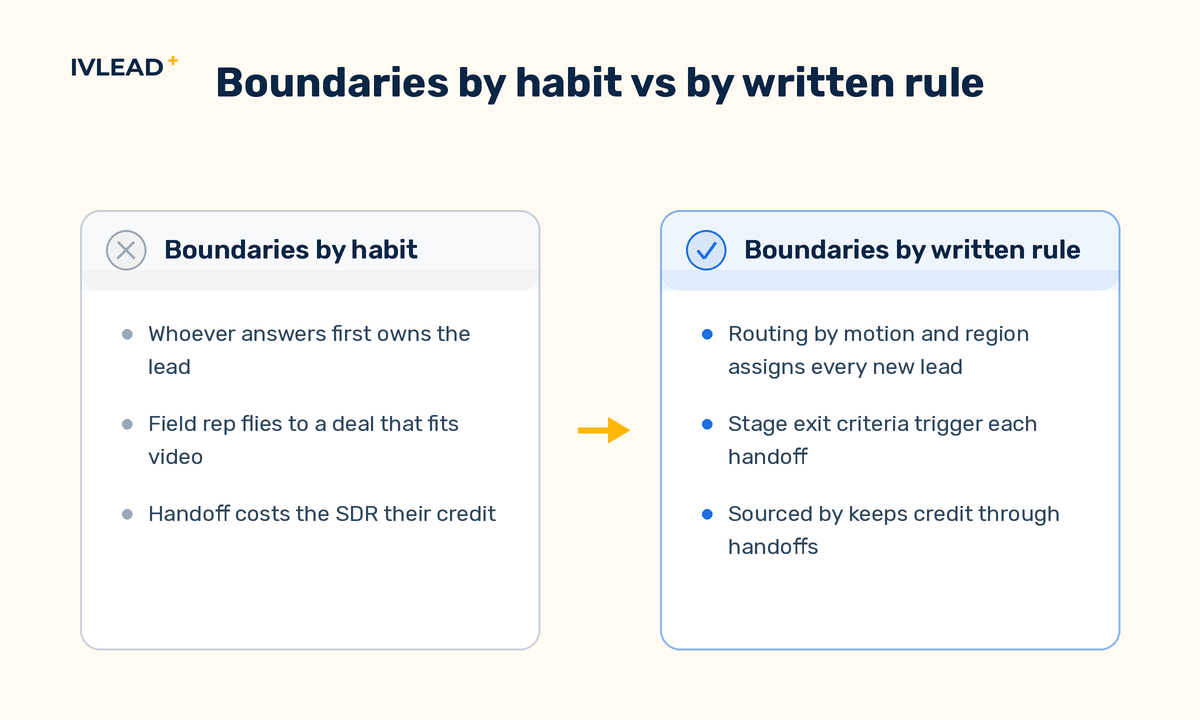
The structure holds or fails on four boundary rules, each written in one sentence and stored where the CRM can act on it:
- Which accounts and deals belong to the inside group and which to the field group.
- What event moves a deal from an SDR to an AE, and from an inside AE to a field AE when a deal outgrows its segment.
- Who owns the company record and who owns each deal when the two differ.
- Who keeps credit when ownership changes, so a handoff does not cost the sender their commission.
What does a blended team look like in HubSpot?
For example, a company that sells production-monitoring software to manufacturers has two offers: a per-site subscription at roughly 9,000 USD a year that a plant manager can approve, and multi-plant rollouts from around 150,000 USD that need ERP integration, a security review and a site visit. One team of twelve sells both. The HubSpot setup could look like this.
Segment rule. A company property Account tier (Tier 1, Tier 2, Tier 3). Tier 1 is a maintained list of named enterprise accounts. Tier 2 is any manufacturer with three or more sites, which matches the multi-plant offer. Tier 3 is everything else, including large single-plant firms that will buy the subscription. A workflow sets Sales motion (Inside, Field) from the tier: Tier 1 and Tier 2 become Field, Tier 3 becomes Inside. A Region property, one value per field territory, records where the main site is.
Exceptions. Anyone who changes Sales motion by hand also fills in Motion override reason, and the tier-to-motion automation should leave records with a reason alone, so a later tier update cannot undo an agreed exception. A monthly list of companies with Sales motion Field, Account tier Tier 3 and no override reason catches changes made without one.
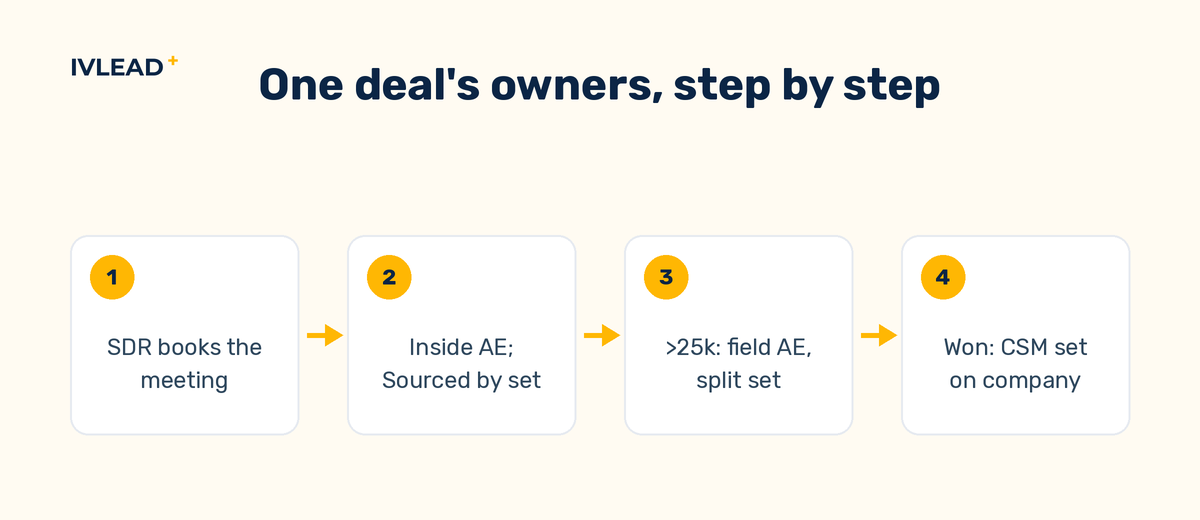
Teams and owners. Four teams: SDR, Inside AE, Field AE and Customer Success. The company owner is an AE from the team matching the motion: for Field companies, the field AE assigned to that Region; for Inside companies, the next inside AE in a rotation when Sales motion is first set. The SDR who books the first meeting owns the deal until discovery is held.
Pipeline. One pipeline, New business, with an exit criterion per stage: Meeting booked (discovery call on the calendar), Discovery held (pain, budget holder and timeline recorded in Qualification notes), Solution agreed (scope confirmed in writing), Proposal sent, Verbal yes, Closed won, Closed lost. Each deal carries its own Deal motion (Inside, Field), copied from the company when the deal is created. A dropdown Site visit status (Completed, Not required) is a required conditional stage property for Proposal sent. That requirement covers every deal entering the stage, so automation sets Not required when Deal motion is Inside.
Handoff and credit. When a deal enters Discovery held, the SDR who owns it is recorded in Sourced by and the deal moves to the company owner. SDR compensation reports run on Sourced by, so the handoff does not cost the SDR credit. If an inside deal passes 25,000 USD in Amount, its Deal motion switches to Field: that deal alone moves to the field AE for the company's Region, the inside AE is recorded in Transferred from for a split, and Site visit status is cleared so the field AE has to record the visit. The company stays Inside, so its next small subscription still goes to the inside team. Agree the split percentage in the compensation plan before the first transfer.
After the close. On Closed won, a CSM from the Customer Success team is set on the company; the AE remains deal owner for reporting. Expansion deals are created under the company owner, so the CSM spots the opportunity and the AE sells it.
Routing. New inbound contacts whose company is Field go to that company's owner; everyone else rotates across the SDR team. Contacts with no associated company go to an SDR, who sets the company, tier and region on the first call.
Access. Team-based permissions can hide inside accounts from field reps, but hidden records make handoffs harder, so use them sparingly.
Reports. Win rate and cycle length by Deal motion, and Meeting booked to Discovery held conversion by SDR. These show whether the 25,000 USD threshold and the three-site cut-off are in the right place.
Every number here is an illustration. The part to copy is the order of the rules, and that each one lives in a property a report can measure.
What goes wrong, and how do you check for it?
Each failure below can be caught with a saved list or report.
- Deal owner in the wrong team. Usually a manual reassignment on one record. Check: open deals past Discovery held whose owner's team does not match
Deal motion. - Motion property empty. The tier was never set, so routing fell to a default. Check: companies with an open deal and
Sales motionblank. - Unassigned leads. Rotation includes a user who left, or a form created contacts without a company. Check: contacts created more than two days ago with no owner, or owned by a deactivated user.
- Stage drift on field deals. The rep works the deal in person and updates nothing. Check: open deals with no logged activity in 30 days, grouped by owner.
- Lost SDR credit. An AE created the deal directly after a meeting the SDR booked. Check: closed-won deals last quarter where
Sourced byis not on the SDR team but an SDR logged the first meeting with the contact. - Deals created at the finish line. A field rep ran the cycle outside the CRM and logged only the win. Check: deals that reached Closed won within 14 days of creation with an amount above the field threshold.
Run these checks monthly; each hit points to a rule that is missing or not enforced.
How IV-Lead approaches this
Our view is that the inside-versus-outside question is mostly settled for B2B companies with more than a handful of reps: most run a blend. The decision that still matters is where the boundary sits and whether the system enforces it. We would rather a client pick a slightly wrong threshold and store it as a property than pick the perfect threshold and leave it in a slide deck, because a stored rule can be measured and corrected.
For existing customers whose class or turnover already lives in an ERP such as Priority, Account tier can be fed from the integration, so sales and finance share one definition of a large customer. New prospects are not in the ERP yet, so their tier is still set by hand or from enrichment data. How we build that routing and reporting is described on our HubSpot implementation and automation page.
If you are unsure whether your HubSpot setup enforces your team structure or quietly undoes it, you can book a 30-minute portal audit and we will review ownership and routing with you.
Frequently asked questions
Can one rep do both inside and outside sales?
Yes in a small team, but it rarely scales. High-volume remote work and a few deep in-person relationships need different daily rhythms, so growing companies usually separate the roles and measure each on its own numbers.
How do you set the threshold between inside and field deals?
Start with deal value compared with the full cost of a visit, then adjust using win rate and cycle length by motion. If field deals just above the threshold do not win more often than inside deals just below it, raise the threshold.
Does outside sales still make sense now that video is normal?
Yes, for segments where buyers expect to meet the delivery team or see a demo on their own equipment. Early stages usually happen on video now, so the visit moves to the point in the cycle where it changes the outcome.
How do you get field reps to keep the CRM current?
Make logging short and required at stage changes: a mobile note after each meeting, and a required property before the proposal stage. Reports that managers use in pipeline reviews are a stronger incentive than reminders.